
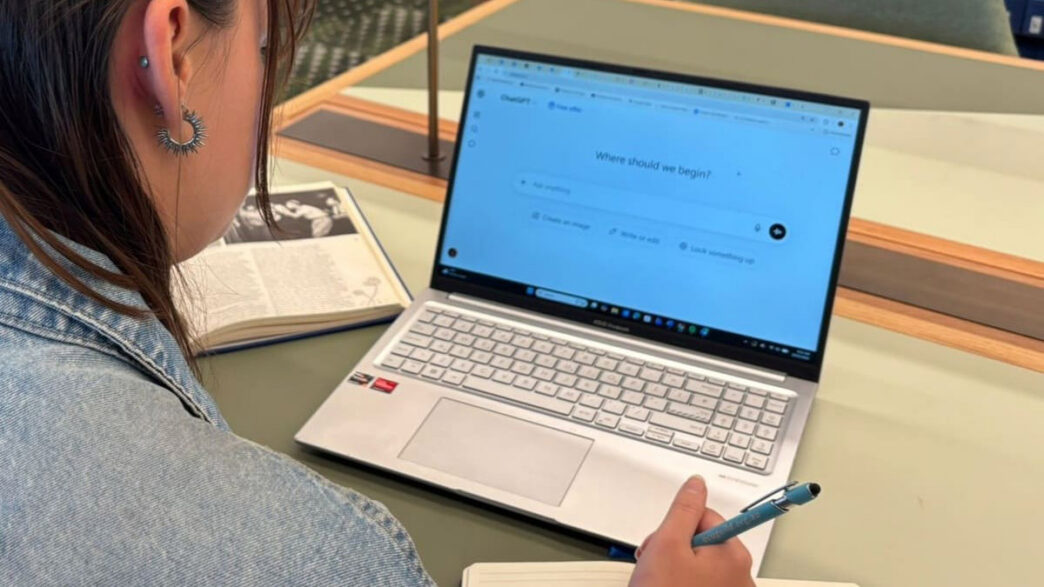
AI has become embedded in our higher education system and is an everyday part of students’ lives.
This has changed how students learn, research and approach assignments.
In 2025, almost 80 per cent of university students in Australia reported using AI in their studies, raising concerns over academic integrity, the value of assignments and the future of education.
For some students, the rise of AI has created anxiety over academic assignments and AI detection, with fears that they will be falsely flagged for AI generation.
A tool or a crutch?
Lilly Warburton, a cybercrime and counter terrorism student, has seen AI become prominent in the university world.
“People use it for everything,” she says.
While some students use AI as a learning tool, Warburton says some have become too reliant on it.
“It’s like a crutch for people’s work.”
She believes this has changed the mindset of students towards university and academic effort.
“I don’t understand why you would come to uni and not put the effort in.
“It’s frustrating because seeing [people who have used AI] get an amazing grade for work that they didn’t do is disheartening.”
Concerns over AI detection have also changed the way students approach assignments, leaving mistakes in from drafts to prove that their work is real.
“We’re way more likely to leave grammatical mistakes in that dumb down our language, dumb down the sentence structure.
“Because if you’re using high-quality vocabulary or something, that can come up as AI.”
Warburton says that this uncertainty over detection has left her and other students feeling under pressure when completing and submitting assignments.
“It’s a case of how do you defend yourself? How do you prove you haven’t used it? You know, how do they prove you have?”
Rethinking assessment
Antony Tibbs, AI Product Owner at ECU, says that we cannot accurately flag a piece of work as being AI-generated.
“The problem with AI detection is that all of the evidence shows that it’s very unreliable.”
Universities are now having to consider changes to how assignments are approached in this new age.
He suggests universities are shifting away from just looking at the final product of students’ work.
“Previously, you could have assigned somebody a piece of writing, and you would expect that they wrote that piece of work,” he says.
“Now that AI can increasingly do all of those steps, the shift is much more around looking at the process.”
This approach would help identify gaps in students’ learning and understanding of assignment content.
The risk to learning
Tibbs says research suggests that it is not just academic integrity that is the problem, but a potential for “cognitive atrophy”.
“If you basically delegate or offload your work, then you can be short-circuiting your learning process.”
But, as Tibbs continues to point out, the human tendency is just to want the easy route.
“Everybody likes a shortcut. We all don’t like to take the hard way.”
“Learning is effortful, and effective learning is quite hard work.”
Charlotte Goodwin

Hi! My name is Charlotte and I am a third year Global Comms and Media student from the University of Portsmouth in the UK! I am on a year exchange here at ECU as part of my dual degree, and major in journalism.