The Road Safety Commission statistics show Western Australia’s road fatality rate fell by 6.1 per cent in 2015.
Since then, the toll has crept back up, with fatalities in 2026 already running 30 per cent higher than the same period last year by mid-May.
A Road Safety Commission (RSC) spokesperson said improvements in enforcement and education have helped reduce deaths on WA roads.
“Right now, we’re just keeping the lid on a simmering pot.”
The RSC also placed responsibility firmly with individual road users.
“Safer roads, safer speeds, safer cars and more enforcement only work if the driver behind the wheel or the person on a motorbike, bicycle or eRideable are following the road rules and changing their driving or riding to the conditions,” said RSC.
The road toll for WA stands at 86 deaths.
Behind the death toll lies a mounting financial burden for WA drivers.
The hidden cost of every crash
Insurance Commission of WA (ICWA) reported crash related costs are at $135,539,760 as of 31 March 2026.
The commission also reported in 2025 a total of $636,591,534.33 in crash-related costs, indicating the ongoing financial burden of road accidents on the states insurance scheme.
In the same year, ICWA reported a comprehensive list of costs which includes, but not limited to ambulance services, care accommodation, health and legal fees. The single largest line item reported is “future expenses” – long-term obligations for ongoing medical costs and other injury-related expenses – totaling $30,732,407.
Those costs flow through to insurers – and ultimately to drivers, whose compulsory third party (CTP) premiums fund motor vehicle claims.
Criminal and Civil Lawyer Louis Durand said insurers influence governments to introduce laws that generate revenue from the CTP.
“The insurers soon get the sitting governments to implement laws, so they can start collecting some form of revenue from those road users.”
Mr Durand also said new technologies such as e-scooters are complicating the legal landscape, since no license is required to ride them.
“They are new forms of toys, we haven’t worked out where they should go, and consequently, they’re using the footpath,” he said.
The Insurance Commission of Western Australia declined to comment.
Beyond the human cost, the broader fatality picture for WA in 2026 shows no sign of improvement.
In a recent report by the Road Safety Commission, WA is tracking well above the recent average of deaths per year.
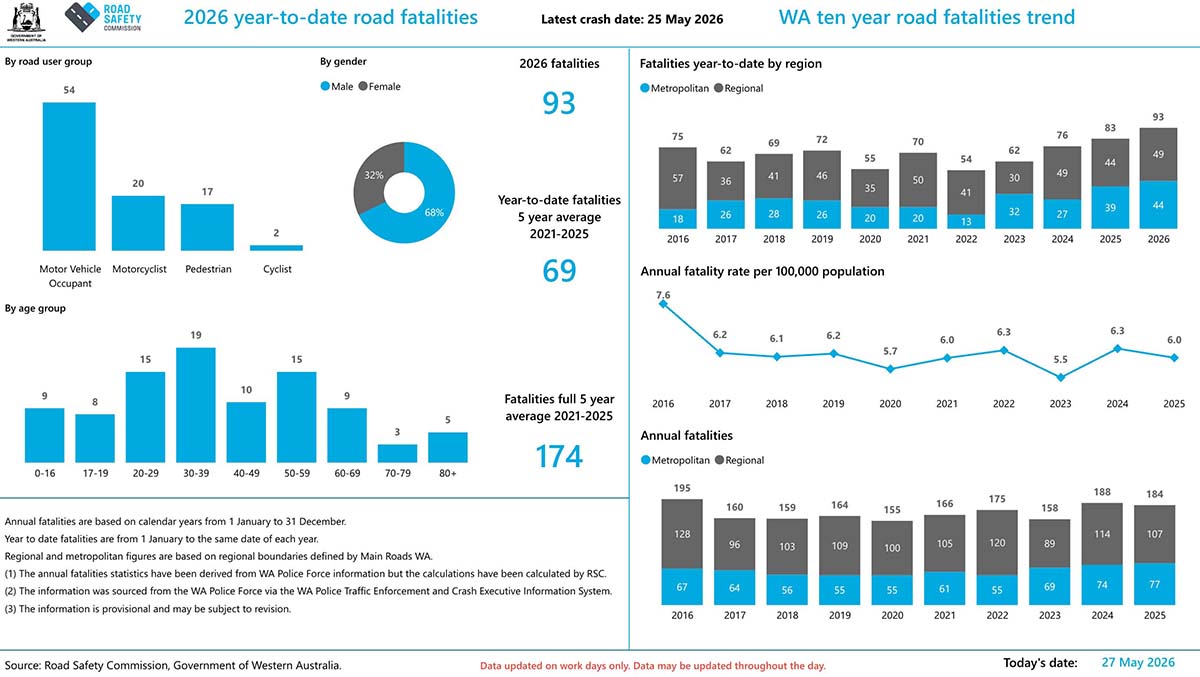
Year-to-date fatalities stand at 69 – above the five-year average recorded between 2012 and 2025.
The grim statistics coincided with National Road Safety Week, as pedestrian deaths and the overall toll continue to rise.
Minister for Police Reece Whitby has urged all drivers to take responsibility for road safety.
“Everyone has a part to play when it comes to road safety, and no one knows that better than our emergency and first responders who witness the aftermath of serious and fatal crashes,” he said.
Figures released in early May confirmed the WA death toll is tracking higher in 2026 than it was at the same point in 2025.
Shadow Minister for Road Safety Julie Freeman called out the worsening trend.
“Three people have now lost their lives on WA roads, exceeding the 69 fatalities recorded at this point last year, reinforcing a deeply concerning trend in road trauma across the State,” she said.
Millions unspent while deaths are rising
Ms Freeman also questioned why allocated safety funding has gone unspent.
“In 2022–23, $95 million remained unused. In 2023–24, that figure grew to $120 million.
“That is funding that should already have been delivering safer roads, particularly in regional WA.”
Despite the pressure, the RSC pointed to a longer arc of progress.
“Western Australia has made significant improvements to road safety over the past 50 years.”
Western Australia has spent 50 years making its roads safer. Right now, it is losing ground.
Ra Castel

I am a journalist student at ECU, YouTuber and Content producer with over 249K views on TikTok, 25K+ views on Instagram reels and posts and 4k views on YouTube. My intent for my works to progress into more video journalism that will cover all sorts of topics from entertainment and breaking news. Other journalist mediums I am interested in diving into are podcasting, radio and content creation. You can find me on all social media platforms and Linkedin for more content.