Dementia is now the leading cause of death in Australia.
In 2026, an estimated 446,500 Australians are living with this condition.
Research by the Alzheimer’s Society suggests that older people who regularly exercise can reduce their risk of dementia.
Edith Cowan Professor of Translational Genomics, Professor Simon Law seconds this idea, believing exercise is a viable preventative.
“Keeping people healthy and active for [a] long [time], could be a potential preventative factor for later stage dementia development,” he says.
The recommendation is that people exercise for 30 minutes per day.
Movement and connection
While general physical activity is beneficial, he also believes it is best paired with social interactions.
“For example group sessions, in the gyms, aerobic classes and so forth, bring with it social interaction, which is also a key factor.”
Combining exercise with social engagement helps keep the mind active.
“It’s a multifactorial approach to health and well-being, particularly for prevention of later life health conditions such as dementia,” says Professor Law.
Murdoch Professor of Psychology and Clinical Neuroscience, Professor Hamid Sohrabi agrees that social exercise is beneficial but under supervision.
“We encourage anyone to start activity at any age that they can.
“However, we encourage people to do physical activity with the supervision of their medical doctrine.”
Professor Sohrabi says when people do not consider their own abilities and restrictions, potential damage could be caused.
He believes this should not discourage people and that regular exercise is still extremely beneficial.
“Physical activity in any form could significantly contribute to our cognitive abilities and also minimise the risk of dementia in the future.”
Social exercise in practice
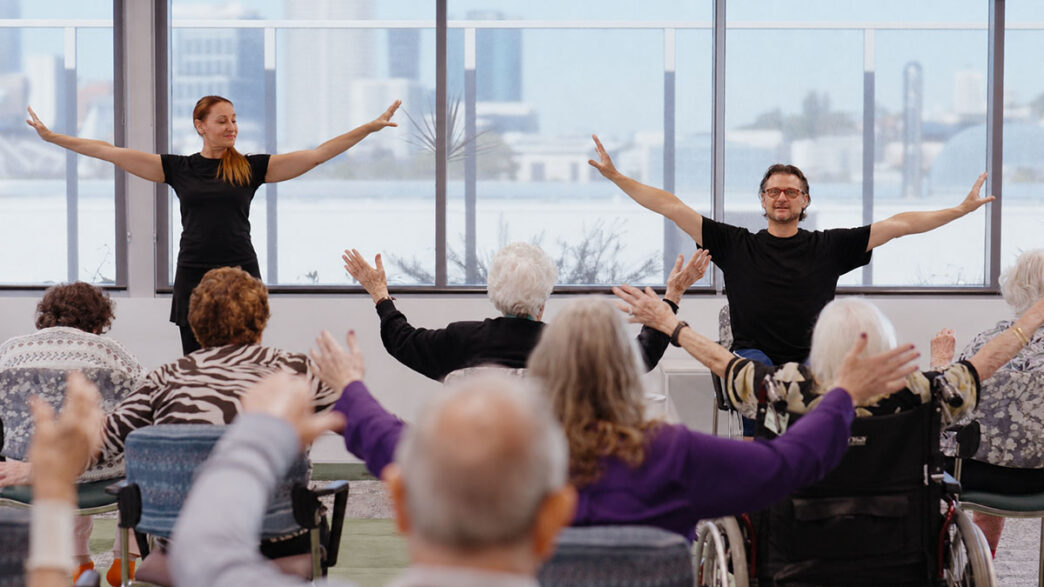
At Ballet 4 Wellbeing specialised seated ballet classes are offered for the elderly who want to combine exercise and socialising.
The classes are designed to include gentle movement, making them suitable for all members of the community.
The Co-founder of Ballet 4 Wellbeing, Aurelien Scannella believes that the combination of music and movement is especially good for the elderly.
“It really helps the cognitive side and also if you’ve got some mobility issues.
“We sometimes underestimate the power of music, what music can trigger in each individual,” Mr Scannella says.
As well as the physical benefits, Mr Scannella also sees the positive effect that socialising has on his senior participants.
“They come together as a group, they do the same exercises, listen to the same beautiful music and they will continue the discussion for most of the time they have lunch.
“Residents do anticipate our sessions, they really look forward to the next one,” he says.
All classes are supervised and the movements are tailored to an individual’s needs.
“When we sit in a room with residents, we immediately are able to feel the room and see who we’ve got in front of us, and we are able to adapt the method to the residents we have.”
Mr Scannella runs the classes in his father’s memory and is glad to do his part for the community.
“After each session, there’s always a few people, you know, wanting to talk to you and share a little bit of their history and their lives.
“People who used to go to attend the Ballet performances or Opera, can’t attend anymore, so now we are bringing the Ballet to them,” Mr Scannella says.
Ariana Koskela-Reyes

Ariana Koskela-Reyes is a third-year Bachelor of Global Media and Communications student at the University of Portsmouth in the United Kingdom. She is currently on exchange at Edith Cowan University as part of a dual degree program, majoring in Journalism.