




Leaving an abusive relationship can be a critical step towards safety, but rebuilding a life afterwards brings its own challenges.
For women escaping domestic and family violence, financial insecurity, unstable housing and disrupted employment can make independence difficult to achieve.
And for some, financial abuse means starting over with little money, limited resources and debts they never agreed to take on.
Associate Professor Natalie Gately, a criminologist at Edith Cowan University, says financial dependence can be part of the control experienced within abusive relationships.
“Many women have been dependent on their abusive partners,” Dr Gately said.
She said some women leave relationships with fewer financial resources, disrupted employment histories and safety concerns that can make rebuilding independence difficult.
According to the Australian Institute of Health and Welfare, following the end of an abusive relationship, 69 per cent of women relocate for their safety, often abandoning their property and personal assets in the process.
Financial insecurity can continue long after women leave.
Dr Gately said women often face several challenges simultaneously, including accommodation costs, limited employment opportunities, childcare responsibilities and debts accumulated in their names.
“Some men have also forced debts into their partners’ names, meaning women leave with debts as well as access to no money,” she said.
The Australian Bureau of Statistics reports, 1.6 million women experienced partner economic abuse in 2021-22.
With the Australian Institute of Health and Welfare also identifying economic abuse as one of the financial impacts of family and domestic violence, including controlling income, refusing to contribute to household or child related expenses and forcing financial liabilities onto a partner.
More than a pay cheque
For Dr Gately, employment can play an important role in rebuilding a woman’s independence.
“Stable and fulfilling employment does so much more than just provide wages.”
Dr Gately said employment and regular income can also help rebuild confidence and social connections for women who have spent periods in isolation.
“Women can find security in regular income and can start planning the future,” she said.
“They build confidence in being able to provide for themselves and their children.”
When it comes to both finding and maintaining employment, it is not always as straightforward as it seems.
Women may find themselves with little to no skills, limited confidence and having gaps in their employment history after being told they cannot survive without their partner.
Dr Gately said trauma can also affect a woman’s ability to work, with anxiety, post-traumatic stress and lack of sleep.
Creating a pathway back into work
For Mettle Gifts CEO Chealsea Hunter, these barriers are something the organisation sees firsthand.
Mettle Gifts is an Australian social enterprise providing transitional employment to women experiencing homelessness following domestic and family violence.
Through its six-month program, women gain paid work experience, develop new skills and receive support as they work towards longer-term employment.
With this program no one leaves until they have secured ongoing employment.
The organisation was founded by Bronwyn Bate, a 2026 WA Local Hero nominee.
Bate launched Mettle Women Inc after researching the experiences of young women living in domestic violence shelters and identifying that access to employment is a significant barrier to these women wanting to rebuild their lives.
Hunter, who has been Mettle’s CEO for 6 months, said the organisation aims to provide women with a safe and supportive workplace where they can develop skills and confidence.
Some women entering the program have never worked before or have never worked in Australia.
Hunter said 81 per cent of the women Mettle supports have an active restraining order in place, while 63per cent of the women do not have access to a car. “These barriers are huge for the women that we support,” Hunter said.
The program is designed to provide so much more than just employment.
Women receive support with rental and crisis costs, as well as opportunities to receive education scholarships.
Hunter said success can look different for every woman.
For Mettle Gifts, the goal is to create a pathway from crisis towards stability.
Between 2019 and 2025, Hunter said Mettle supported 954 women and paid more than $500,000 in wages to women experiencing crisis accommodation.
She said 81 per cent of graduates remained in stable employment one to three years after completing the program, while 87% were in stable accommodation.
Women in the program make products including hand creams, candles, room sprays and body scrubs, which are packaged into gift boxes and then sold through Mettle.
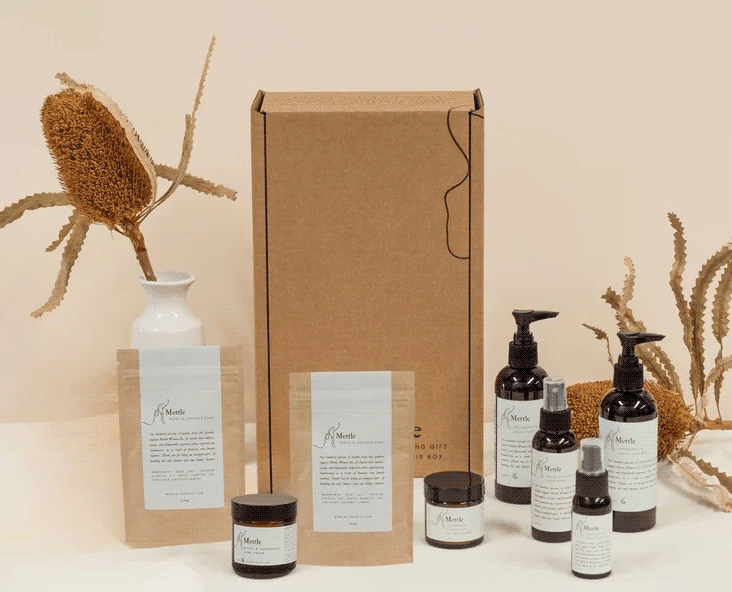
Women in Mettle’s program produce and package products including candles, hand creams, body scrubs and gift hampers.
“Every gift box is prepared or made by women in the program,” Hunter said.
Behind each box is an opportunity to build skills, regain confidence and take another step towards financial independence.
If you or someone you know is experiencing family and domestic violence, support is available. Contact 1800RESPECT or visit their website for confidential support and assistance.


