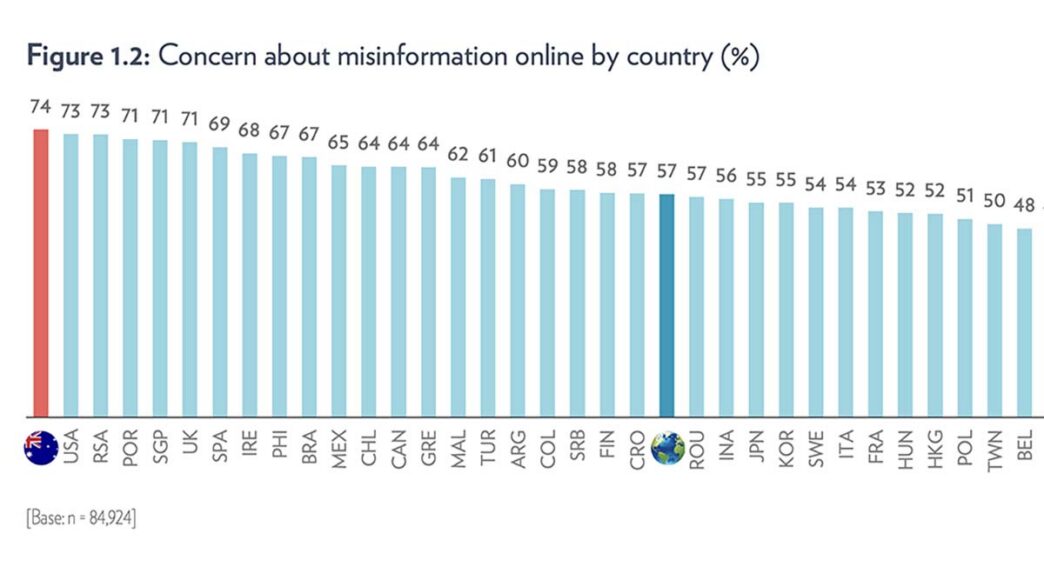
The 2025 Digital News Report issued by the University of Canberra’s News and Media Research Centre has cited that Australians maintain the highest degree of concern for misinformation globally, with 74 per cent of Australians concerned about online misinformation.
In the foreword to the report, Vice Chancellor Bill Shorten wrote that while the US comes a close second, “Americans have lost trust in mainstream news media and turned away from it, depending more heavily on social media for their information. Australians are not far behind, but traditional media is holding on in the trust stakes.”
The global news landscape is currently experiencing transformation, as social media platforms become a linchpin for daily news. Despite this, Australians are approaching this new outlet with caution while maintaining a degree of trust in traditional outlets, the inverse of what is unfolding in America.
What is misinformation?
The Australian Communications and Media Authority (ACMA) defines misinformation as misleading, false, or deceptive information that can cause harm.
Misinformation can occur through two avenues, the first being a deliberate attempt to spread false or deceptive information to create confusion, undermine trust, or lure people. The second is the accidental spreading of false information without the intent of causing harm, largely due to limited fact-checking.
Why are Australians becoming increasingly vulnerable to misinformation?
The way Australians receive their news is changing, with more Australians accessing social media platforms rather than traditional outlets or online news, creating more avenues for misinformation.
Over its tenure, traditional news media have established a set of codes and practices that enable the maintenance of reporting reliable, fact-checked information. This is not the case for news received through social media.
“On digital platforms, the widespread use of algorithms, the proliferation of sources and the dissociation of content from its source can make it challenging to assess quality and make informed decisions about which news and information to read and trust,” the ACMA stated in a 2020 misinformation and news quality position paper.
According to the paper, two key issues arising from receiving news through social media are the inability of users to easily determine the quality of information, and the targeting and frequency with which users are exposed to incorrect and unregulated reporting.
These elements tend to develop a vicious circle, fuelling each other and worsening the problem.
What is being done to combat this issue?
Real progress in combating misinformation has yet to be seen, despite attempts being made. In 2024, the Australian government proposed a Communications Legislation Amendment seeking to impose obligations on online communication platforms that shared information which could be reasonably verified as misleading or false.
However, this amendment was not passed due to uncertainty about how to legislate it. Another implication of this proposal was that it focused on younger generations and how they accessed news, overlooking older generations and their news habits. Critics of the amendment highlighted that it could be harmful if fact-checkers were run by unrestrained powers and could be considered government intervention in free speech.
As it stands, the best avenue to tackle misinformation is personal verification. According to the Digital News Report, Australians are the most attentive globally to misinformation, with 39 per cent of Australians saying they turn to trusted news sources or official sources to verify reporting, and 28 per cent of Australians employ fact-checking websites to avoid misinformation.
What can you do to reduce your risk?
The ACMA has outlined a set of tips to help reduce the risk of falling victim to misinformation. These include: checking the source, carefully inspecting visual media for manipulation, further verifying facts and information, and reading beyond the headline.
It is also recommended to gather news from a variety of sources to verify the authenticity of the information provided and to more effectively kibosh any misinformation.
The way in which the world receives news is transitioning from traditional mainstream news outlets to social media. With this comes new risks, predominantly the threat of misinformation. Whether that be through deliberate attempts to misrepresent the truth or the accidental sharing of unverified reports, these new outlets lack the codes and practices that traditional media is built on.
While Australians maintain the highest degree of concern for misinformation globally, the increase in misinformation has never been greater and the threat it poses should not be taken lightly, with everyone having a role to play.
In this changing landscape, it is imperative that those seeking current news and affairs ensure that they are receiving factual reporting from trusted sources and fact-check the information received, especially if ascertained from social media.