
Australia’s Temporary Graduate visa application cost $2,300 at the beginning of the year. Now it costs $5,750.
For international graduates who have already spent tens of thousands of dollars on tuition and living costs, the increase has made staying in Australia another significant financial decision.
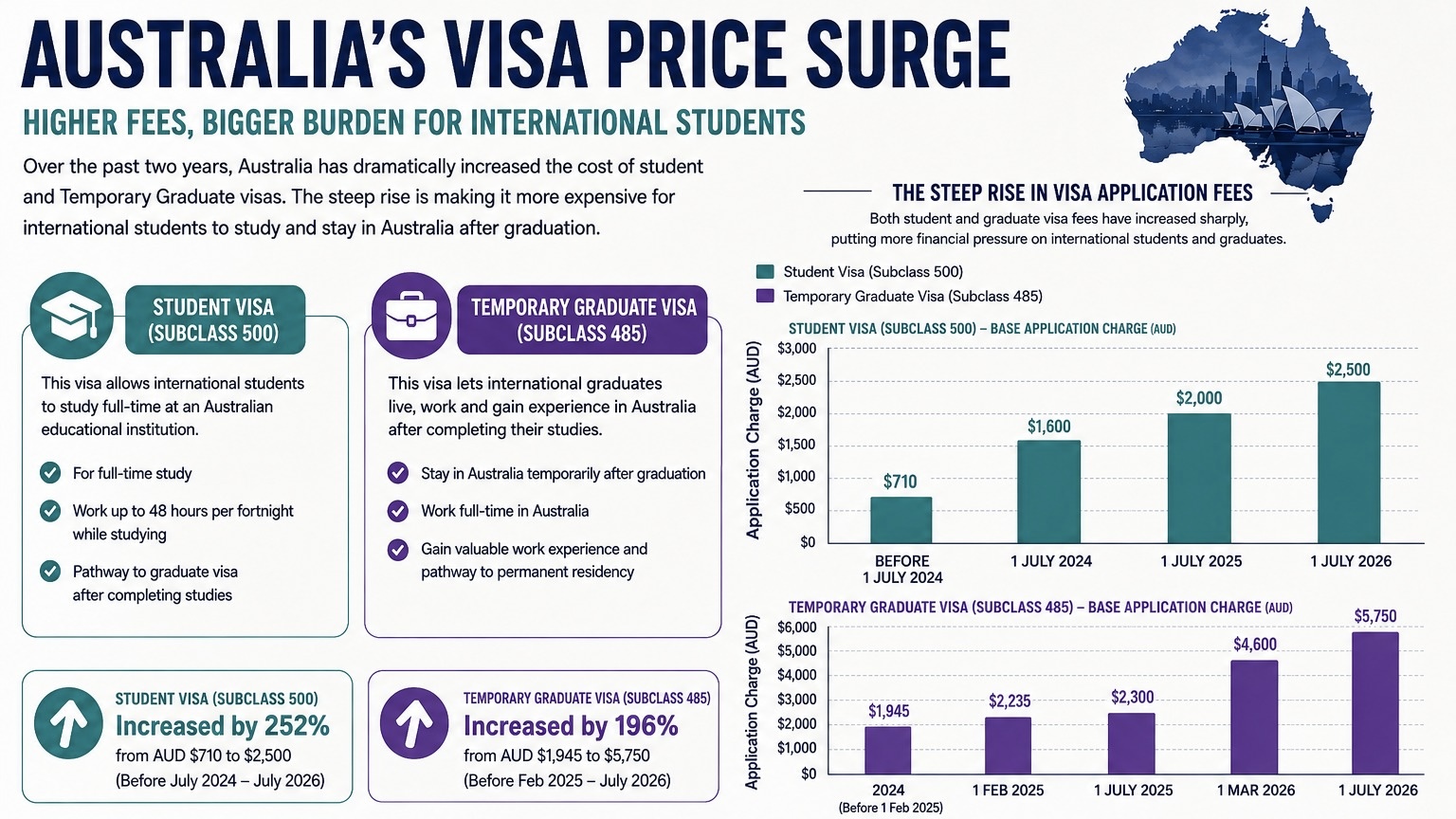
The cost of applying for both Student and Temporary Graduate visas has risen sharply over the past two years.
The Student visa (subclass 500) base application charge rose from $710 before July 2024 to $1,600 that month, then to $2,000 in July 2025 and $2,500 in July 2026 — an increase of 252 per cent in two years.
The Temporary Graduate visa (subclass 485) increased from $1,945 before February 2025 to $2,235 that month and $2,300 in July 2025. The charge then doubled to $4,600 in March 2026 before increasing again to $5,750 in July.
Recent international graduate Sarah Er experienced the increases while preparing to apply for a Temporary Graduate visa.
Er had planned to apply for the visa after finishing university, but the application charge increased twice as she prepared to graduate.
“I knew the graduate visa was expensive, so I had started saving for it since last year. But then the prices have increased twice this year,” she said.
Throughout her studies, Er worked in retail to save money for the upcoming visa fee.
As the cost rose, Er wanted to work more to cover it, but student visa holders are limited to 48 hours of work per fortnight while their course is in session.
“Every time I felt like I was getting closer to my goal, the visa fee increased again,” she said.
“I didn’t want to ask my parents for help because they’ve already sacrificed so much for my education, but eventually I had no choice to ask for their help.”
More expensive and harder to get
While visa costs have increased, international students are also facing a higher rate of visa refusals.
Department of Home Affairs data shows the student visa refusal rate reached 24.2 per cent in June 2026, its highest level in a decade. In comparison, the refusal rate was 7.9 per cent in June 2016.
The Australian Government said the visa fee increases are part of broader changes aimed at keeping international student numbers at a more sustainable level.
The Australian Government said the July fee increases were part of broader measures aimed at managing international student numbers and supporting a sustainable international education sector.
But from the perspective of international students, the rising costs are becoming part of the decision about where to study.
Indonesian high school student Rachelle Ferraris said the rising costs had prompted her to consider studying somewhere other than Australia.
“Australia was one of my first choices, it has amazing universities and good environment,” she said.
“But when I calculated the tuition fees, visa costs, and living expenses, it became overwhelming.”
Instead, Ferraris has started looking at universities in China, where she believes she can also receive a high-quality education at a significantly lower overall cost.
“At the end of the day, my family has to think about what we can realistically afford. If another country offers good education without putting so much financial pressure on us, then it is something we must seriously consider.”
When staying becomes unaffordable
Migration agent Indah Melindasar, who assists international students with visa and permanent residency pathways, said rising visa costs had become one of the biggest concerns raised by her clients this year.
According to Melindasar, the issue is no longer whether graduates want to stay in Australia or not, it is whether they can afford to.
“Many students have already invested tens of thousands of dollars in tuition fees over several years,” she said.
“When they finish their studies, they’re suddenly faced with another visa application that costs several thousand dollars. For some people, that’s simply out of reach.”
Melindasar said some of her clients were delaying their applications while they saved more money, while others had abandoned plans to remain in Australia and returned home.
For some, Australia remains a country of opportunity. For others, that opportunity is becoming increasingly difficult to afford.
Genyvra Caecillia

Genyvra Caecillia is a Journalism and Broadcast Media student at Edith Cowan University. Passionate about news, politics, and storytelling, she enjoys producing meaningful stories that inform, engage, and connect communities.