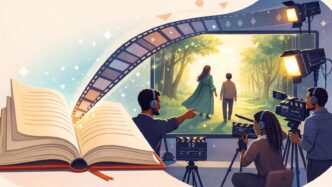

From Fourth Wing to The Love Hypothesis and the Off Campus series, Prime Video is turning bestselling novels into films and television series. And it’s far from the only streaming service embracing adaptations.
For readers, it can feel like every week brings news of another favourite book being adapted.
While seeing a beloved story brought to life can be exciting, it raises another question: are filmmakers finding new ways to tell stories, or simply running out of original ideas?
The rise of book-to-screen adaptations isn’t new. Some of the most successful films and television shows have been based on novels. What feels different now is the amount of adaptations being announced, particularly within romance, fantasy and the books we see a lot on ‘BookTok’.
The popularity of adaptations is also reflected in Netflix’s viewing figures. The streaming giant reported that book-based films and series attracted more than nine billion global views in 2025, accounting for almost 20 per cent of viewing hours. Adaptations also featured in its Global Top 10 rankings every week during the first three months of 2026.
Their success helps explain why streaming services continue investing in stories that already have established audiences.
However, for readers, the appeal is about more than simply seeing a familiar title on a streaming service.
For owner of To Be Read bookstore, Lauren Allen, adaptations can create an opportunity for stories to reach people who may never have picked up the original novel.
“I think it’s amazing and brings more things to a community who haven’t discovered the books yet. It brings so much more to the community – I love it,” Allen said.
“A lot of people have just watched the Off Campus show and are now reading the books and loving them too.”
A television series or film can introduce an entirely new audience to a book, encouraging viewers to return to the source material and discover the community that already exists around it.
It is a cycle that can benefit both sides, a successful adaptation can send audiences back to bookstores, while the popularity of the original book can give a new production an audience before it has even premiered.
For authors, it can also mean seeing worlds they created in their heads become something much bigger.
“I say keep it coming. When they do it true to the book, as much as they can, it really is incredible to see it come to life,” said author Nicole Bazley.
However, bringing a book to the screen is not as simple as transferring words from a page to a script. This becomes particularly complicated with fantasy.
Unlike a contemporary romance set in a recognisable world, fantasy can require historical structures, magic, creatures and fictional landscapes to be created from scratch.
“I have incredible mixed feelings about it.” Shares fantasy author, Alicia Dingley, “In general I’m not a big fan – especially with my genre in fantasy, it is very hard to adapt into live action. If they maybe made an adult animation of it, they could get a more accurate adaptation.”
The excitement of finally seeing a favourite character or fictional world on screen comes with expectations. Readers have already imagined what characters look like, how they speak and how their world operates. When filmmakers make changes, those decisions can be met with enthusiasm or disappointment.
Yet adaptation does not necessarily mean copying a book word-for-word.
Film and television have different storytelling tools. A novel can spend hundreds of pages inside a character’s thoughts, while a television series must communicate emotion through performance, dialogue, visuals and sound and maintain the viewers’ attention.
That means changes will be necessary. The challenge is deciding which parts of a story are essential to preserve.
So, is Hollywood becoming too reliant on stories that have already proven themselves?
Avid reader, Charlise Varischetti-Rattigan believes a lot of it because of a lack of creativity. “They take books that are so loved and completely change big plot points. I feel that they use the readers to get an audience but aren’t taking on their favourite parts of the book.”
She continues, “In a lot of instances they can be really good and bring in new readers, like The Hunger Games did and they stay true to the original material, but other times they bring in a competitive audience who argue over what was better: the book or the film.”
There is certainly a financial logic behind choosing an established book: a popular novel already has an existing audience who are very likely to watch the screen version.
The influence of ‘BookTok’ has strengthened that appeal. Studios can see which stories already have passionate communities behind them, making popular books an attractive source of potential screen hits.
Perhaps calling adaptations “lazy” overlooks what they can achieve.
A book may have hundreds of thousands of readers, but an adaptation can introduce the same characters and stories to millions of people who would never have discovered them otherwise. For fantasy and romance especially, that can mean opening the door to worlds that once seemed too niche for mainstream television or film.
For readers, there is something undeniably appealing about watching a world they once imagined come to life. And when an adaptation succeeds, it doesn’t necessarily replace the book — it can give audiences another reason to discover it.